A. Molina & C. S.p.A. has always built its business on values of responsibility, transparency and respect, with a strong focus on animal welfare, environmental protection and people’s health.
Our long-standing experience in feather and down processing is backed by a concrete commitment to ethical and sustainable production practices, certified by internationally recognised independent bodies.
Animal Welfare and Responsible Supply Chain
We have always held a deep commitment to animal welfare, ensuring that the feathers and down used in our products come exclusively from a controlled, traceable and transparent supply chain.
Every stage of the production process is carefully monitored to ensure that materials are not sourced from live animals or animals subjected to mistreatment, in full compliance with the most stringent regulations and ethical standards.
This commitment is confirmed by international certifications that demonstrate our constant attention to this matter.
RDS
Molina is a company certified under the Responsible Down Standard (RDS), the leading international benchmark for animal welfare in feather and down production.
The RDS certification:
ensures responsible practices throughout the entire supply chain
independently certifies compliance with animal welfare standards
guarantees full traceability of materials throughout the entire production process
A. Molina & C. S.p.A. has voluntarily adopted the Downpass standard, committing to monitoring and verifying the entire filling supply chain.
Thanks to Downpass:
every batch of material is tracked
products are certified as not sourced from live or mistreated animals
full transparency is guaranteed to clients and consumers
Environmental Care and Recycled Materials
Alongside natural down, Molina has been investing for years in the development of sustainable synthetic fillings, made from recycled materials.
This choice contributes to:
reducing environmental impact
promoting the circular economy
limiting the consumption of virgin resources
GRS
Molina is a company certified under the Global Recycled Standard (GRS), a standard that verifies recycled material content, ensures traceability throughout the entire production chain, and requires compliance with responsible environmental and social practices.
People’s Safety and Well-being – OEKO-TEX®
All Molina products are free from harmful substances and safe for human health.
STANDARD 100 by OEKO-TEX
The STANDARD 100 by OEKO-TEX® certificate guarantees that every component of our products is tested and compliant with the strictest chemical limits, ensuring:
safety in contact with the skin
consumer health protection
high quality standards
Hypoallergenic and Anti-dust Mite Products
Our duvets, quilts and pillows are also suitable for people with dust allergies.
ANTI-DUST MITE AND HYPOALLERGENIC
Thanks to a particularly tight weave, Molina products:
are hypoallergenic
offer effective protection against dust mites
ensure comfort and well-being during rest
Our Associations
A. Molina & C. S.p.A. has always been active at national and international level within the leading industry associations, confirming our role and commitment in the sector.
We are members of:
ASSOPIUMAAssopiuma Association is the Italian Association that brings together feather and down processing companies.
Assopiuma Association guarantees that the information on labels regarding the composition and treatment of fillings is truthful and accurate, in compliance with current hygiene and health regulations (European Standard EN 12934).
For more information: https://assopiuma.org/
IDFB The IDFB Association, International Down and Feather Bureau, is the global association of the industry’s companies.
For more information: https://idfb.net/
Feather and down are naturally sustainable, renewable and biodegradable materials, with a significantly lower environmental impact compared to synthetic alternatives. For Molina Piumini, sustainability is a concrete commitment based on measurable data, supply chain traceability and compliance with international regulations.
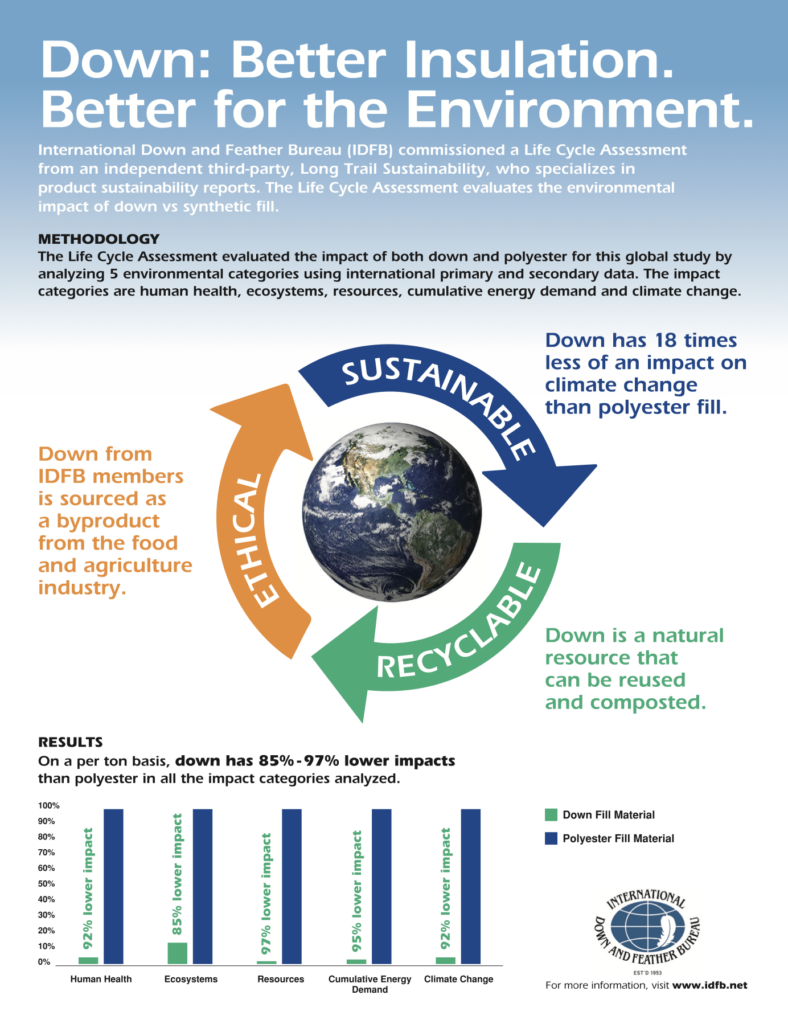
In order to support the environmental benefits of feather and down with scientific evidence, the International Down and Feather Bureau (IDFB), the body responsible for defining test methods and reference standards for the feather and down industry, of which Dr. Andrea Molina is Chairman of the technical committee, has commissioned independent studies aimed at quantifying its environmental impact across the entire life cycle. In this context, a Life Cycle Assessment (LCA) analysis conducted by a specialised third-party organisation compared down filling with polyester filling.
The study assessed five key areas: human health, ecosystems, resource utilisation, cumulative energy demand and climate change. The results show that, on the basis of one tonne of material, down has an environmental impact 85%–97% lower than polyester across all categories analysed, and a climate change impact up to 18 times lower.
The use of high-performance natural materials, combined with controlled production processes and traceable supply chains, enables Molina Piumini to offer reliable and responsible solutions for the lifestyle, fashion and high-end home sectors, contributing to a concrete reduction in the environmental footprint of finished products.